
H5 bird flu and Australia’s wildlife: the risks to our native species and how to help
This page explains the risks H5 bird flu poses to Australia’s native wildlife, what to do if you see affected birds or wildlife, and what can be done to help. For guidance on protecting cats, dogs and backyard birds, see our companion page, H5 bird flu and your pets.
- Wildlife & H5 bird flu. Overseas H5 bird flu has killed wild birds and marine mammals in very large numbers, and Australia has now recorded its first mass death of native wildlife from the virus.
- Birds that gather in dense colonies are most exposed — terns, gulls, gannets and albatrosses can pass the virus quickly through a colony. Seals and sea lions are a serious concern among mammals.
- 386 native bird and mammal species are rated at high to extreme risk in the Australian Government’s assessment.
- The virus has reached mammals. A long-nosed fur seal, a common dolphin and a red fox have all been confirmed in South Australia. There is no evidence of mammal-to-mammal transmission in Australia.
- Vaccination has begun. A national program announced in August 2026 is targeting the captive birds most at risk, starting with species such as the orange-bellied parrot.
- The spread cannot be stopped, but its impact can be lessened. Surveillance, reporting, and building the resilience of our wildlife all shape the outcome.
- How individuals and communities respond is key. Reporting sick or dead wildlife is one of the most useful things anyone can do — keep your distance, don’t touch the animal, record what you see, and call the Emergency Animal Disease Hotline on 1800 675 888.
Why is wildlife at risk from H5 bird flu?
H5 bird flu is a disease of wild birds and the animals that live alongside them. The strain now circulating — H5N1 clade 2.3.4.4b — has spread across the world since 2021 with an impact never seen before, killing wild birds in their millions and crossing into many species of wild mammals. Where a virus like this reaches animals that live and breed in large, dense groups, it can spread very quickly. There is no treatment for H5 bird flu in wildlife.
That is the heart of the concern for Australia. Our coasts and islands hold internationally significant breeding colonies of seabirds, and our beaches and offshore islands are home to seals and sea lions found nowhere else. Many of these animals have never encountered this virus, so how badly they will be affected is impossible to predict.
How you can help
Community reports are how surveillance teams track where the virus is and identify locations that need investigation. Australians have made more than 25,000 reports to the Emergency Animal Disease Hotline since the outbreak began, and the first confirmed mammal case in the country came from a member of the public reporting a dead seal on a beach. Even a single sick or dead bird is worth reporting, and dead birds can stay infectious for up to 30 days at 20°C, and longer in colder conditions - so carcasses matter as much as visibly sick birds and wildlife.
Avian influenza is a nationally notifiable disease and the advice is simple: Avoid. Record. Report.
Avoid — do not touch sick or dead birds or other animals, their feathers, droppings, or the area around them. Keep your distance, and keep pets away — don’t let pets sniff, eat or carry a carcass.
Record — note the date and time, the location (a GPS pin, nearby roads or landmarks), the type and number of animals, and what they look like. Take photos or a video.
Report — call the 24-hour Emergency Animal Disease Hotline on 1800 675 888.
Should I call WIRES?
The wildlife rehabilitation sector is not expected to play an active operational role during outbreaks. WIRES’s role at this stage is to continue risk-mitigation planning, support community awareness, and comply with government directives on the reporting, rescue and care of affected animals. WIRES advise that if you have found an injured or orphaned native animal and are unsure about what to do, you can call 1300 094 737 for advice, otherwise, for sick and dead birds and wildlife, call the 24-hour hotline on 1800 675 888.
Add your voice: the wildlife resilience fund
Conservation organisations are running public campaigns calling on the Australian Government to establish a wildlife resilience fund — a $200 million investment to help vulnerable native species survive H5 bird flu outbreaks. Funding is needed to boost the populations of the most susceptible species and reduce other pressures — restore wetlands and clear invasive predators such as feral cats, foxes and pigs from seabird breeding islands.
"A no-regrets investment: even setting bird flu aside, the same work leaves wetlands restored and islands cleared of predators, and wildlife more resilient to every other threat."
Support the campaign by adding your name through BirdLife Australia or the Invasive Species Council.
Download these Department of Agriculture, Fisheries and Forestry resources to help educate and raise awareness of H5 bird flu. Infographics relating to pets are on our H5 bird flu and pets page.
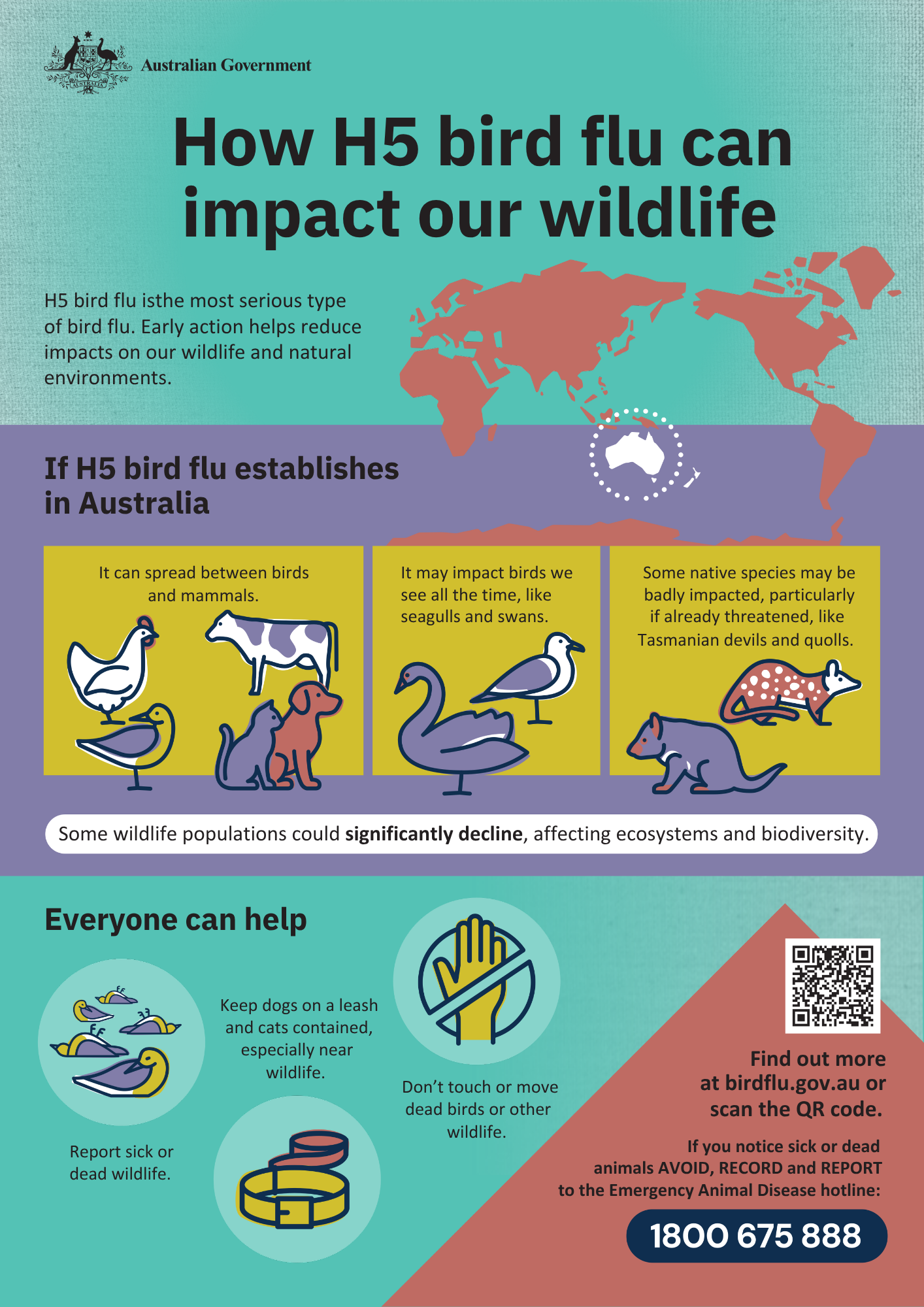
How H5 bird flu can impact our wildlife
Download (PDF)
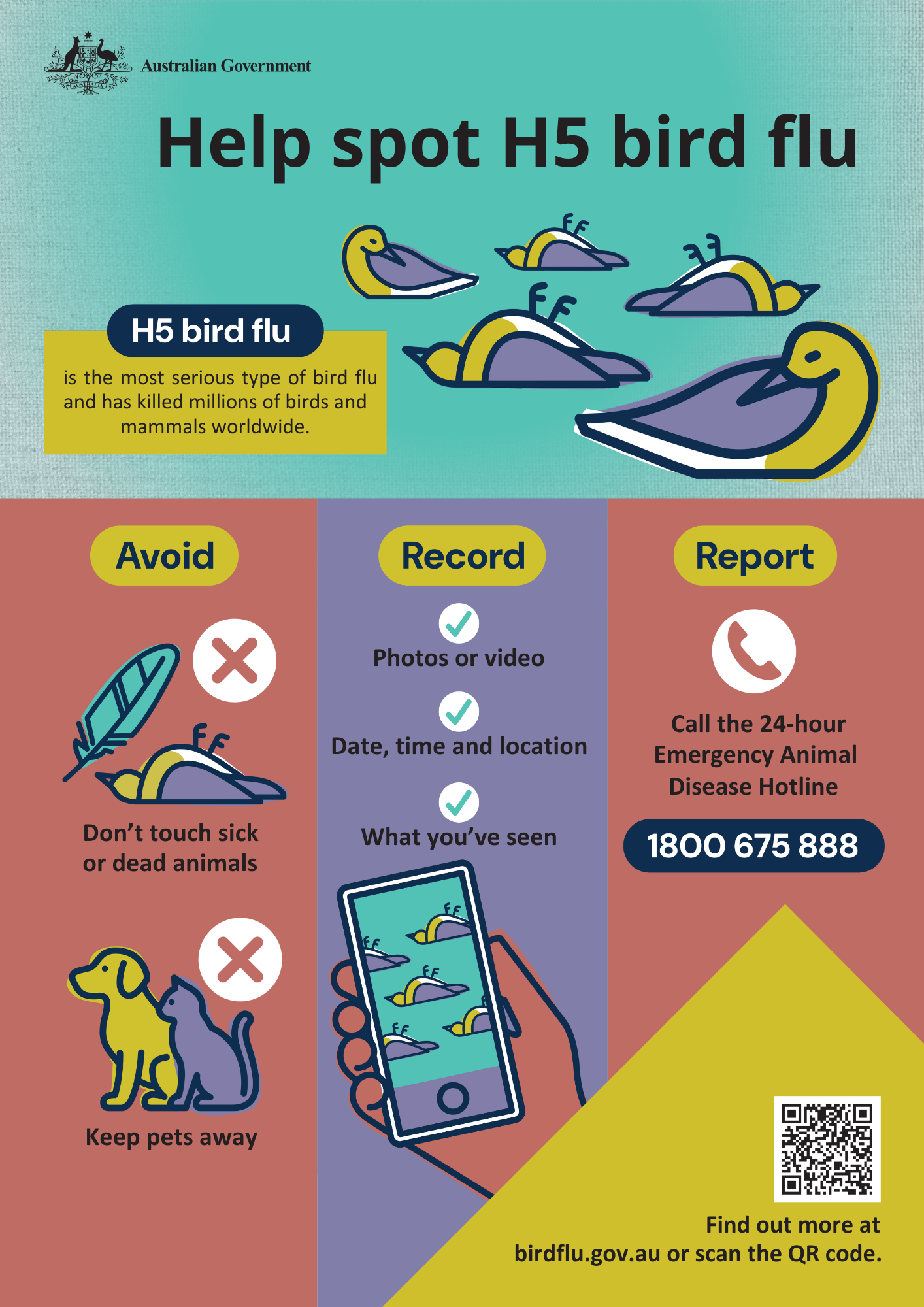
Help spot H5 bird flu
Download (PDF)
Which birds are most affected
Overseas, the wild birds hit hardest have been those that congregate in numbers: seabirds such as terns, gulls, gannets and albatrosses; waterfowl such as ducks, swans and geese; shorebirds; and the predatory and scavenging birds — eagles and others — that feed on infected animals. Terns, gulls, gannets and albatrosses can transmit the virus rapidly once it reaches a colony.
Australia’s first confirmed mass death was at Baudin Rocks off Cape Jaffa on the South Australian coast in August 2026, where 49 greater crested terns were found dead and 35 more sick. Greater crested terns have borne the brunt since: South Australia has reported three further mass mortality events on remote offshore islands involving more than 1,000 of them, presumed to be H5 bird flu. Tasmania has recorded penguin deaths within weeks of the virus reaching the state, including about 100 at Stokes Point on King Island — too decayed to test, but enough for authorities to act.
More than twenty species have now been confirmed. Greater crested terns account for the great majority of events, followed well behind by silver gulls. Beyond them the list runs across giant petrels, little penguins, Pacific gulls, black-faced and great pied cormorants, Australasian gannets, brown skuas, shearwaters, white-fronted and white-headed petrels — and, tellingly, birds that are not seabirds at all: Australian magpies, several species of raven, a peregrine falcon and a southern boobook. Scavenging and hunting birds are turning up because they eat what has already died.
The virus is also moving along the New South Wales coast. Detections at Narooma and Merimbula on the far south coast, in greater crested terns and a giant petrel, follow earlier cases at Eden, Hawks Nest and Wentworth — the last of these well inland on the Murray. Gulls travel long distances and move between the coast and inland waterways, and can carry the virus far beyond the beaches where it first appears. According to Burnet Institute chief health officer Suman Majumdar, Australians should expect further spread along coastlines, with mass mortality events in seabirds and marine mammals in the weeks ahead.
In August 2026 the Australian Government published a risk analysis ranking more than 2,000 native birds and mammals. It found 386 species at high to extreme risk. Five birds are rated at extreme risk: the Christmas Island frigatebird, Houtman albatross, Herald petrel, and the imperial shags of Heard Island and Macquarie Island. These are species that gather at only a few sites, where a single outbreak could affect a large share of the population.
How H5 bird flu affects seals and sea lions
Three Australian mammals were confirmed with H5 bird flu in August 2026, all in South Australia. A long-nosed fur seal found dead at Beachport was the first, reported to the Emergency Animal Disease Hotline by a member of the public. A common dolphin at Goolwa followed — the first cetacean case here, though dolphins and porpoises have been infected overseas. Then a red fox at Osborne in metropolitan Adelaide, the first land mammal.
Australia’s Chief Veterinary Officer, Dr Beth Cookson, has been clear that there is no evidence of mammal-to-mammal transmission in Australia. Overseas, infections in scavenging carnivores such as foxes are believed to be isolated spillover events from birds. Each of these animals is thought to have been infected by eating or coming into close contact with an infected bird, or its environment.
Marine mammals that live in close contact with seabirds have been among the hardest hit wherever this virus has spread. In June 2026 H5 bird flu was confirmed on Heard Island — a remote sub-Antarctic Australian external territory roughly 4,000 kilometres south-west of Perth — where it was linked to the deaths of over 13,000 elephant seal pups, around three-quarters of the pups on the island. In April 2026 the southern elephant seal was listed as vulnerable on the IUCN Red List, in part because of bird flu mortality, and recovery is expected to take decades.
The Australian sea lion, Australian and long-nosed fur seals and southern elephant seal are the marine mammals identified as most at risk here, and dolphins are also in the high-risk categories.
Why the Australian sea lion is the pressing concern
Fewer than 10,000 Australian sea lions remain, with about 85 per cent of them in South Australia. One of the largest and most stable breeding colonies is on The Pages, small islands between Kangaroo Island and the mainland. In August 2026 South Australia reported three mass bird mortality events on remote offshore islands, involving more than 1,000 greater crested terns and presumed to be H5 bird flu; two were at The Pages. Infected terns have also been confirmed at Seal Bay on Kangaroo Island, another major sea lion site.
The species was already under pressure. Associate Professor Rachael Gray, a University of Sydney veterinarian who studies Australian sea lions, reports that government observers counted 84 dead pups across two visits to The Pages in the 2025 breeding season — a mortality rate above 34 per cent, against a recent average of 5 per cent. The deaths were largely attributed to the algal bloom, with a lack of food stressing mothers and pups.
Work is under way to build resilience. State and federal governments committed $1.4 million to worming pups and building shelters at colony sites, which Dr Gray describes as giving pups a better chance of growing well, so that when a threat like avian influenza arrives they are better placed to cope with it. She also notes one possible advantage: unlike other pinnipeds, Australian sea lion pups are born over an extended period rather than in a tight window, so a virus arriving when few pups are present might do less damage — though she says it is too early to tell.
Jack Gough, chief executive of the Invasive Species Council, has warned that mammal-to-mammal transmission moved quickly among seals when the virus reached South America and Antarctica, where around 30,000 elephant seals died, and that colony collapses are a realistic prospect here. For the Australian sea lion, he says, this could be an extinction-level event.
There is no ready answer for mammals. South Australian Environment Minister Emily Bourke has said there is no off-the-shelf vaccine for marine mammals, and that no country has found one in the five years this strain has been circulating. South Australia has told the federal government it is willing to explore the approach trialled in Hawaiian monk seals, while noting it is not an approved vaccination.
Native mammals and marsupials
Overseas, H5 bird flu has affected birds and mammals but has not been found to infect animals such as reptiles, fish and amphibians. Among mammals, the animals most often infected are those that prey on or scavenge birds, along with the marine mammals covered above. Several of our most distinctive mammals are scavengers.
The Australian Government’s risk assessment rates the Tasmanian devil and eastern quoll as the highest-risk land mammals. Wildlife Health Australia’s national coordinator, Dr Tiggy Grillo, has said the species that could be at risk in Australia include Tasmanian devils, quolls and the rakali, a native water rat - all scavengers that could encounter the virus through an infected carcass.
The red fox confirmed at Osborne in August 2026 showed that pathway is real. Professor Michael Ward, a veterinary public health expert at the University of Sydney, describes the fox as a bridge species: there are an estimated 1.7 million red foxes across 80 per cent of the continent, and an animal that scavenges an infected carcass on the coast can carry the virus a long way inland, to environments and species that have had no contact with seabirds. A fox can also contaminate pasture, where the virus may persist if conditions are right. It is, in his words, almost a perfect way to spread the disease.
That cuts both ways for our native scavengers. The same behaviour that puts foxes at risk puts devils, quolls and rakali at risk — and a fox moving inland could carry the virus to them. Tasmania’s Parks and Wildlife Service has begun feral cat control on King Island as a precaution after about 100 dead penguins were found there, on the basis that scavenging animals can spread the virus by eating infected carcasses or moving them around.
Almost nothing is known about how marsupials respond to this virus - because most marsupials live only in Australia. The one exception is the North American Virginia opossum, the only marsupial known to have been killed by H5 bird flu so far. Experts still describe the risk to Australia’s marsupials as a genuine unknown.
Tasmanian devils scavenge along rocky shores where seabirds nest and rest, so coastal populations are the most likely to be exposed — and because devils range widely, an animal that eats an infected bird on the coast could carry the virus many kilometres inland. University of Sydney population biologist Professor Carolyn Hogg has noted that devils have low diversity in the immune genes used to detect new diseases, which is a problem when a novel disease arrives. Their numbers are already low — devil facial tumour disease has cut the population sharply — so a fast-spreading virus could be devastating.
Preparation is already under way to protect a number of particularly vulnerable species. Perth Zoo, the only place in the world that breeds the endangered numbat, has roofed its previously open-air enclosures to stop wild-bird droppings falling onto the insects the numbats eat, and is looking at back-up diets to reduce that exposure further. Similar biosecurity work and “insurance populations” — secure captive groups held as a safeguard — are being established for quolls and other susceptible marsupials, so that a species could survive even if the virus reaches wild populations.
What happens next for Australia’s wildlife?
Authorities have been clear that this is the beginning of what is likely to be a long and difficult period for Australia’s wildlife. Once the virus is established in wild birds, it cannot be eradicated. Environment Minister Murray Watt has said he expects more mass mortality events in Australia, and that seeing them will be distressing for people. His stated aim is to keep affected species at population levels where they survive long term, while acknowledging the impacts will be serious.
Each year, large numbers of migratory birds arrive in Australia from the northern hemisphere, gathering in the same coastal wetlands and staging grounds as resident species. Where infected and uninfected birds mix in these dense congregations, the chance of transmission and further mortality events increases. There are serious concerns for the Coorong in South Australia — an internationally significant wetland where large numbers of water birds gather, and already touched by the virus.
For people who spend time outdoors, one practical reality is worth preparing for: it may become more common to come across sick or dead birds on beaches and around waterways. Distressing to see, and knowing what to do — and what not to do — is critical.
Macquarie Island, a World Heritage Australian territory in the Southern Ocean, is home to more than 80,000 southern elephant seals and millions of breeding seabirds. The virus has not reached it yet. In August 2026 the Australian Antarctic Division announced it would withdraw its 24 expeditioners, because the Department of Climate Change, Energy, the Environment and Water considers it likely the virus will kill thousands of elephant seals and their pups in the coming breeding season.
The reason given was the psychological safety of the staff. Deputy secretary Sean Sullivan asked people to imagine living and working among thousands of seals in close proximity, and the distress of watching those animals die without being able to help them. It is the first time an Australian government has taken an action of this scale solely to protect the mental health of its researchers.
Dr Brianna Le-Busque, an environmental psychology researcher at the University of Adelaide, said the effects of witnessing a mass mortality event would be repeated and compounded, and that researchers become deeply attached to the places and species they work to protect. Monitoring and research on the island will continue in the expeditioners’ absence.
In a July 2026 webinar, a group of Australia’s leading science and conservation organisations — the Australian Marine Conservation Society, Biodiversity Council, BirdLife Australia, Doherty Institute, Invasive Species Council and Wildlife Health Australia — discussed the global impact of H5 bird flu, the risks to Australia’s wildlife, and what is needed to strengthen the national response.
What is being done to protect Australia’s wildlife?
The Threatened Species Commissioner has pointed to habitat enhancement, water management, and the control of invasive predators — feral pigs, foxes and feral cats — as ways to give native species the best chance of withstanding the virus when it reaches them. Healthy habitats and strong populations will help wildlife absorb this shock.
Governments and conservation groups are working out which species are most at risk, looking at susceptibility — how likely a population is to encounter the virus, become infected and die — and vulnerability — how badly infection would affect the species as a whole, up to the loss of an entire population. A species that scores high on both, such as a scavenger surviving in small numbers at a single site, is a priority for action.
The Australian Government has committed $113 million, which according to the Biodiversity Council comprises $43.9 million for national coordination, surveillance and biosecurity; $47.1 million to identify the most at-risk species and sites and develop response plans. A further $11.2 million has been promised in the 2026–27 Budget; and $22.1 million to expand pandemic-flu vaccine and antiviral stocks in the National Medical Stockpile. Conservation organisations argue that more is needed to protect wildlife specifically, and are calling for an additional $200 million wildlife resilience fund — the campaign being promoted by BirdLife Australia and the Invasive Species Council.
Could vaccination protect our wildlife?
Vaccination cannot stop H5 bird flu spreading through wildlife. What it could do is prevent an outbreak from wiping out a small, at-risk population in one place.
New Zealand shows what preparation looks like. Its Department of Conservation spent two years trialling vaccination in its most endangered birds before the virus arrived — researching how different species tolerated the vaccine and what doses they needed. That work meant a targeted program was ready to go: 196 of 300 targeted birds across six species have now been vaccinated, all from populations small enough and closely enough managed — GPS tracked, health monitored, often on offshore islands — that individuals can be found, given a booster and followed up. New Zealand recorded its first case in a native bird in July 2026.
Elsewhere, the United States vaccinated 207 California condors by October 2024, after the virus killed 21 of the critically endangered birds. France has trialled a vaccine in wild king penguin chicks on the sub-Antarctic island of Crozet, which produced strong virus-neutralising antibodies with no adverse effects detected.
Australia’s rollout has now begun. In August 2026 the federal government announced a national vaccination program for the native birds most at risk, with around 1,500 vials secured at a cost of about $2 million. States and territories are managing the rollout. Captive birds are the priority, ranked by how vulnerable the species is and how likely it is to encounter the virus; wild birds will be vaccinated where that is possible. Doses vary with the size of the bird, and the government says more vaccine can be secured if needed.
Agriculture Minister Julie Collins said the spread through wild birds cannot be stopped, but action can be taken to protect the species most at risk, and vaccination is now part of that response. Australia’s Chief Veterinary Officer, Dr Beth Cookson, was equally clear that it is not a standalone solution: biosecurity remains essential, and the program rests on 18 months of work on safety and efficacy data.
Tasmania named the first species: up to 350 captive orange-bellied parrots at the Five Mile Beach facility, central to the national breeding program, to be vaccinated ahead of a scheduled release to the wild. In South Australia, Cleland Wildlife Park has begun vaccinating around 30 species in its aviaries using federally approved vaccines.
One wild population is being vaccinated. Little penguins at Phillip Island and St Kilda in Victoria are the first wild species targeted, with the aim of catching and vaccinating around 5,000 of the roughly 40,000 birds in the area. They are viable candidates for a practical reason: they cannot fly, and they return to the same place every night, so they can be found again for a second dose.
South Australia’s penguin colonies are unlikely to be vaccinated. Renee Daniels of the Penneshaw Penguin Centre on Kangaroo Island has said it would be complex because the birds are not microchipped, and each bird needs two doses with monitoring for adverse reactions after the first. The centre has installed foot washing stations and scrubbers instead. As she put it, they are wild birds at the end of the day.
Triage is unavoidable, and it turns as much on whether a species can physically be reached as on how threatened it is. The policy also does not cover non-avian species, so seals and sea lions sit outside it.
That focus on captive birds is not timidity, it is arithmetic. Most H5 vaccines need two doses, and most wild animals are hard to catch once, let alone recapture for a booster. Dr Kirsty Short of the University of Queensland says the practical target is captive animals at risk because they are endangered, rather than field vaccination of wild populations, and that testing a vaccine on a wild population takes around seven months from start to finish. Associate Professor Mohammed Alsharifi of the University of Adelaide, an influenza vaccination expert, says it is the right approach for conserving these species: the virus may yet mutate, but building immunity against the strain now circulating is worth doing.
Australian researchers have been blunt about a gap. Dr Short describes Australia’s surveillance of H5 bird flu as world-class, and says she cannot think of another country that has documented an incursion case by case as thoroughly. But she would have liked to see more research on how the virus affects native species before it arrived: our wildlife is so unusual that findings from the northern hemisphere cannot simply be applied here.
Dr Patrick Finnerty of the University of Sydney puts it more starkly. Ask how the disease will spread through Australian populations, he says, and the answer is usually that we do not really know — which he describes as the frightening part.
Mammals remain the gap. There is no commercially available vaccine for animals like seals. A United States trial using a vaccine developed for cattle showed an immune response in northern elephant seals, but Associate Professor Rachael Gray of the University of Sydney points out how small it was — three animals vaccinated and three controls — and that the logistics of rolling that out across free-ranging populations are formidable. The CSIRO has said there are no specific plans yet to vaccinate seals or sea lions, despite their being among the highest-risk species.
Dr Jane Younger, of the Institute for Marine and Antarctic Studies at the University of Tasmania, argues Australia should begin targeted vaccination of threatened birds now, and develop a strategy for seals and sea lions rather than waiting until thousands are dead. Vaccination is not a silver bullet, she says, but when a disease can undo years of conservation work in weeks, the choice is between an unmanaged catastrophe and a closely tracked outbreak met with stronger surveillance, biosecurity and preparation.
Dr Michelle Campbell-Ward, a wildlife veterinarian at the University of Sydney, makes the same point from the other direction. Vaccination is protective but does not stop infection, and needs updating as the virus mutates. Catching wild birds can itself harm them, so any program has to be planned carefully. What matters most, she says, is surveillance — knowing where the disease is.
For wildlife carers and people who work with birds
Wildlife organisations are expected to support early reporting and surveillance, maintain sound biosecurity, keep themselves and their communities safe, and help raise public awareness. Within that, your own biosecurity matters — both for the animals in your care and for the wild populations around you. General guidance includes:
- Have a biosecurity plan in place for your site or service.
- Keep sick or injured wild birds in care separate from any pet birds or other animals.
- Keep aviaries, bedding and handling equipment clean, and disinfect between animals.
- Know the signs of H5 bird flu, how it spreads, and how to prepare your property.
- Speak to the Emergency Animal Disease 24-hour hotline on 1800 675 888 before disposing of any dead bird — requirements vary between states and situations. You will be connected to an officer in your area.
Watching animals you have worked to protect sicken and die, and being unable to treat them, is its own kind of harm. The Australian Antarctic Division withdrew its Macquarie Island team specifically to protect them from that. Dr Brianna Le-Busque, who researches eco-grief at the University of Adelaide, notes there is growing recognition of the psychological impact on people who work with wildlife, and that these effects are repeated and compounded rather than one-off.
If you care for wildlife, this is worth naming in advance rather than after. Talk to the people you work alongside, and to your organisation, about what support is available before you need it.
Wildlife Health Australia has a free online toolkit for people who care for wildlife, and the Australian Centre for Disease Control has a toolkit for people who work with birds. The Department of Agriculture, Fisheries and Forestry’s wildlife guidance sets out how to protect native wildlife and what to do if you find sick or dead birds, and links to the National Wildlife Biosecurity Guidelines and state and territory resources. Wildlife rescue organisations such as WIRES also publish current advice for their volunteers and the public.
References
- Younger J. Why Australia should urgently vaccinate wildlife most at risk from H5N1 bird flu. The Conversation, 6 August 2026. theconversation.com
- As Australia is hit with mass mortalities, here’s how NZ has prepared for bird flu. SBS News, 7 August 2026. sbs.com.au
- Department of Agriculture, Fisheries and Forestry. H5 bird flu updates — statement of the Australian Chief Veterinary Officer, Dr Beth Cookson. 28 August 2026. agriculture.gov.au
- Bowler J, de Kruijff P. Which animals have been infected by H5N1 bird flu in Australia so far? ABC Science, 29 August 2026. abc.net.au
- First H5N1 bird flu detection confirmed in Australian dolphin. ABC News, 28 August 2026. abc.net.au
- Suspected bird flu infection in fox sparks fears of long-distance spread. ABC News, 26 August 2026. abc.net.au
- Researchers evacuate Australian territory of Macquarie Island as bird flu approaches. SBS News, 28 August 2026. sbs.com.au
- Australia records its first bird flu case in a mammal, minister says. ABC News, 23 August 2026. abc.net.au
- Fears for sea lions as suspected bird flu spreads to breeding ground. ABC News, 23 August 2026. abc.net.au
- New bird flu detections on the NSW far south coast. ABC News, 21 August 2026. abc.net.au
- Bird flu vaccine to be rolled out for Australia’s most at-risk native species. SBS News, 11 August 2026. sbs.com.au
- Primary Industries and Regions South Australia. Update to H5 bird flu reporting. 14 August 2026. pir.sa.gov.au
- Department of Climate Change, Energy, the Environment and Water. Understanding the risk of H5 bird flu to Australian wildlife. dcceew.gov.au
- Department of Climate Change, Energy, the Environment and Water. National risk scores: H5 bird flu in native birds and mammals. dcceew.gov.au
- Everything you need to know about Australia’s bird flu surge. ABC News, 9 August 2026. abc.net.au
- First bird flu mass mortality confirmed in Australian wildlife. ABC News, 3 August 2026. abc.net.au
- Briggs A. Why bird flu poses a high risk to many Australian native mammals. ABC Science, 24 June 2026. abc.net.au
- Ryding S, Ross TA, Klaassen M, Wille M. Impacts of a potential HPAI H5N1 incursion on Australian wildlife. Ecological Society of Australia, May 2025. ecolsoc.org.au
- Biodiversity Council. Bird flu impacts, emerging risks and how to close gaps in the national response. 14 July 2026. biodiversitycouncil.org.au
- BirdLife Australia. Call for stronger protection from H5 bird flu. birdlife.org.au
- Invasive Species Council. Give Australian wildlife a fighting chance against bird flu. invasives.org.au
- Department of Agriculture, Fisheries and Forestry. Help protect wildlife from bird flu. agriculture.gov.au
- Department of Agriculture, Fisheries and Forestry. H5 bird flu detection — national update. As at 27 August 2026. agriculture.gov.au/campaigns/birdflu
- Wildlife Health Australia. H5 Avian Influenza (H5 Bird Flu) and Wildlife — Advice for people who encounter sick or dead wildlife. Version 5.0, June 2026. wildlifehealthaustralia.com.au
- Wildlife Health Australia. H5 bird flu resource centre. wildlifehealthaustralia.com.au
- WIRES. Avian influenza (H5N1). wires.org.au
- Australian Antarctic Program. Scientists determine extent of H5 avian influenza (bird flu) outbreak at Heard Island and McDonald Islands. 18 June 2026. antarctica.gov.au
- Interim Australian Centre for Disease Control. Bird flu (avian influenza). cdc.gov.au
- Australian Museum - Bird Flu testing as mass mortality incident detected