
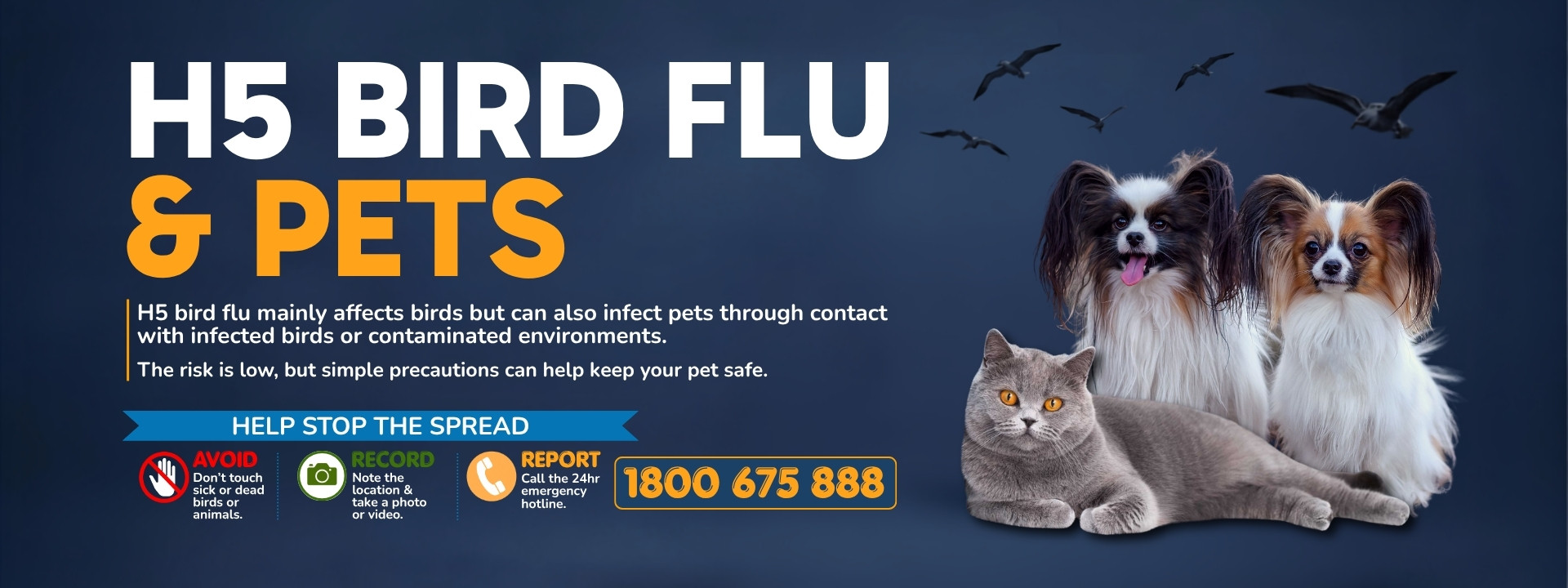
H5 bird flu and your pets: cats, dogs and backyard birds
This page covers the risks H5 bird flu poses to cats, dogs and backyard birds, and how to protect them. For what it means for native animals, see our companion page, H5 bird flu and Australia’s wildlife.
H5 bird flu has now been confirmed in three Australian mammals — a long-nosed fur seal, a common dolphin and a red fox, all in South Australia. Australia’s Chief Veterinary Officer, Dr Beth Cookson, says there is no evidence of mammal-to-mammal transmission in Australia: overseas, cases in scavenging animals like foxes are believed to be isolated spillovers from birds. The risk to cats and dogs remains low, and the precautions on this page are what keep it that way.
Positive events by state — as at 4pm, 27 August 2026
- South Australia — 203
- Victoria — 112
- New South Wales — 14
- Tasmania — 13
- Western Australia — 10
- Queensland — 2
354 positive events nationally, from more than 30,000 reports to the Emergency Animal Disease Hotline. No events have been recorded in the Northern Territory or the ACT. Figures move quickly — the current national count, along with charts by species and state, is published on the Department of Agriculture, Fisheries and Forestry dashboard.
In early August the national figure was reported as 220 individual detections. It is now counted as 354 events. These are not the same measure — the unit of counting changed on 12 August 2026.
Australia now counts events rather than individual animals. One event can involve a single bird or hundreds. A mass death in which more than a thousand terns are found counts as one event; under the old system it would have been hundreds of separate detections. The event figures include everything previously reported, so the same situation is now described in larger, coarser units.
State totals can also jump suddenly. South Australia confirmed 46 events in a single day in late August, not because that many were found at once, but because the state can now confirm positive results from its own Adelaide laboratory rather than routinely referring every sample to the national laboratory in Geelong. Previously suspected cases were confirmed all at once.
Agriculture Minister Julie Collins said counting individual cases was no longer the most accurate picture of how the disease is spreading, and that reporting would focus instead on where the virus is turning up, which species are affected, and emerging areas of risk.
South Australia carries the bulk of events. Greater crested terns have been hit hardest by far, followed by silver gulls, with the virus also confirmed in penguins, cormorants, gannets, magpies, ravens and birds of prey. Agriculture Minister Julie Collins has said Australians should expect more spread and larger numbers of dead birds, including further mass mortalities.
There are still no detections in poultry or the wider agriculture industry, and the risk to human health remains low. This remains a developing situation and we will keep this page updated; for the current national count and the picture in your state, see the official sources below.
- H5 bird flu is mainly a disease of wild birds and some mammals. Close contact with infected birds or animals is what carries the risk to people and pets.
- Cats and dogs are rarely infected, but the illness can be serious if contracted. The risk is highest for pets that hunt or scavenge, so you can protect your pets by preventing any access or exposure to infected birds. Dead birds can stay infectious for up to 30 days at 20°C, and longer in colder conditions - so carcasses matter as much as visibly sick birds and wildlife.
- If you see a sick or dead bird or other animal, do not touch it. Keep a safe distance, take a photo or video if you can, record your location, and report it to the 24 hour Emergency Animal Disease Hotline on 1800 675 888.
Help spread the word
If you find this page useful, please share it — the more pet families and people who spend time outdoors who know what to look for, the better.
Share on Facebook Share on X Share on LinkedIn Share by email
How does H5 bird flu affect pets?
While H5 bird flu has been reported in domestic cats and dogs overseas, the risk to pets has been low. Infection generally requires direct or indirect contact with an infected bird or animal, and Australian veterinarian Dr Sally Coggan says predation and scavenging are the two main pathways.
H5 bird flu and dogs
In dogs the illness appears less severe than in cats, with far fewer cases reported. Dr Coggan says signs can be mild, and in some cases exposure has only been picked up afterwards through antibodies in the bloodstream, showing the dog had been infected at some point without obvious illness.
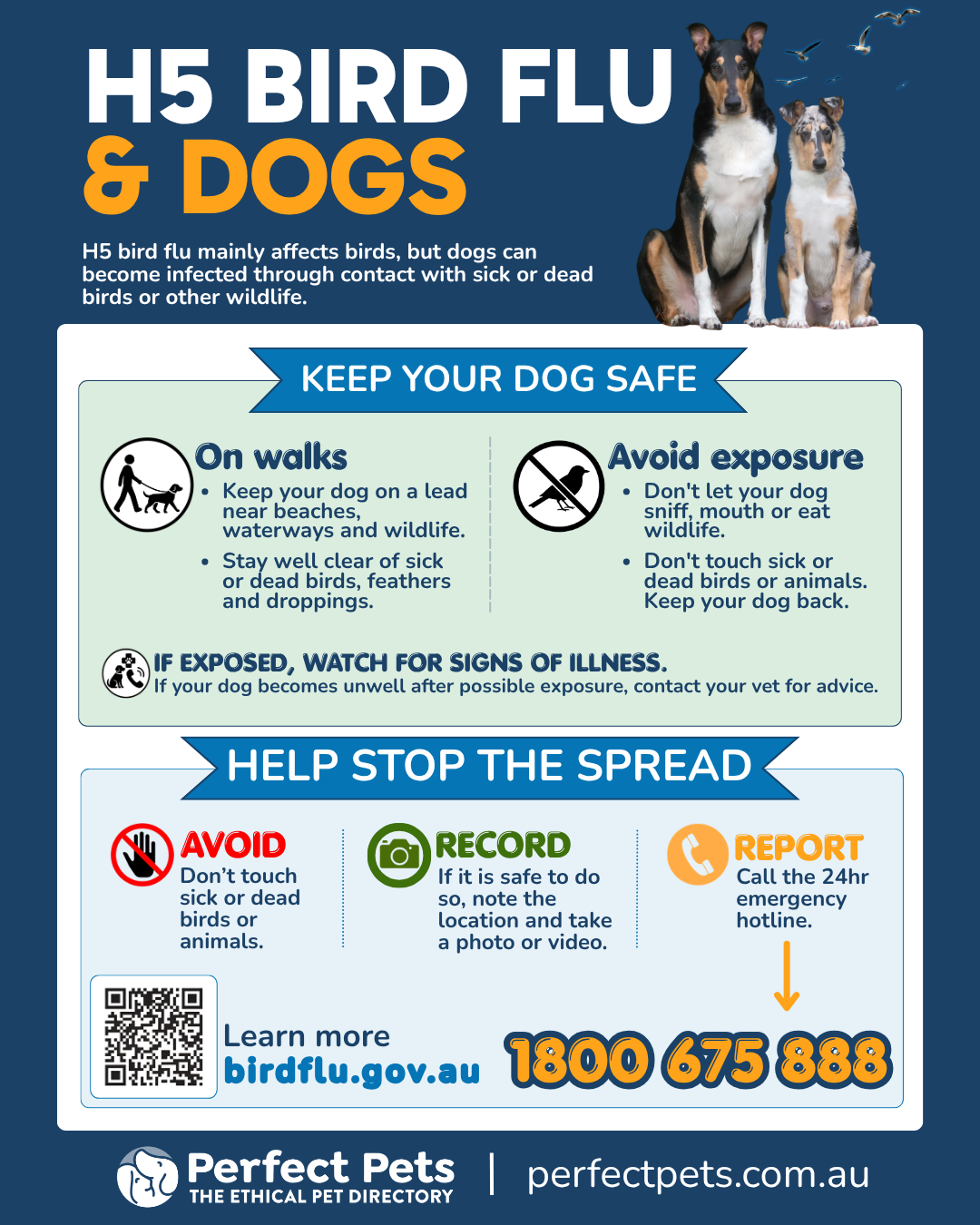
The real risk is for dogs that eat or scavenge dead birds. Dogs drawn to picking up or mouthing birds — which includes many working and retrieving breeds — should be kept well away from sick or dead wildlife. Dr Coggan’s practical advice for dog owners is to keep dogs on lead when walking on beaches in areas where cases have been detected.
- lethargy or sudden fever
- loss of appetite
- coughing or laboured breathing
- swelling around the head, neck or eyes
- diarrhoea
- tremors, seizures or unsteadiness
If your dog becomes unwell after possible exposure, phone your vet before visiting so they can take appropriate precautions.
H5 bird flu and cats
Cats are more seriously affected. Dr Coggan says the illness usually begins with a fever, which can make them acutely lethargic and go off their food, followed by rapidly progressive neurological signs — trouble walking, appearing drunk on their feet, head tremors, or acute blindness — and then respiratory signs. Cats tend to develop symptoms within 24 hours, and most have succumbed within 2 to 3 days of exposure.
Dr Coggan notes that in the United States, only around 200 domestic cats have tested positive in the decade or more since the virus arrived there. Cases are rare — but the illness is severe when it does occur, and hunting or scavenging an infected bird is the usual route.
On treatment, Dr Coggan says data is very limited: the mainstay is supportive care, though Tamiflu (oseltamivir), a human antiviral, has been used successfully in two cats. No vaccines are available for H5N1 in cats. The May 2026 review, Avian Influenza and Feline Patients, is a useful resource for vets and anyone wanting detailed information on symptoms and protocols for suspected cases.
- fever, sudden lethargy or weakness
- loss of appetite
- trouble walking, unsteadiness, head tremors or sudden blindness
- seizures, loss of coordination or circling
- difficulty breathing, coughing, or discharge from the nose or eyes
Illness can progress very quickly. If your cat shows these signs, especially after outdoor access or possible contact with birds, phone your vet before you arrive so they can take appropriate precautions.
A note on ferrets
Ferrets are highly susceptible to influenza viruses, but like cats, kept indoors their exposure risk is very low.
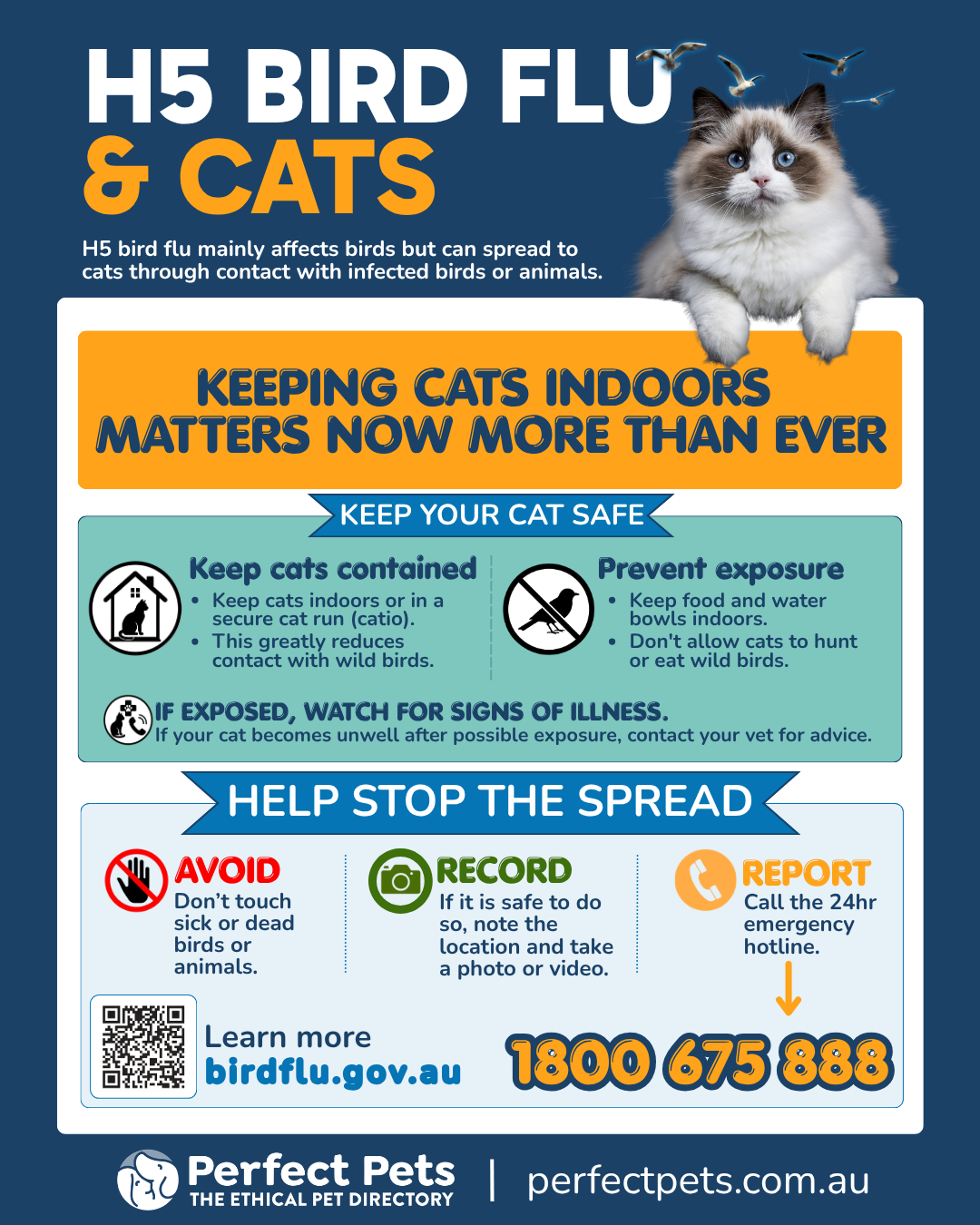
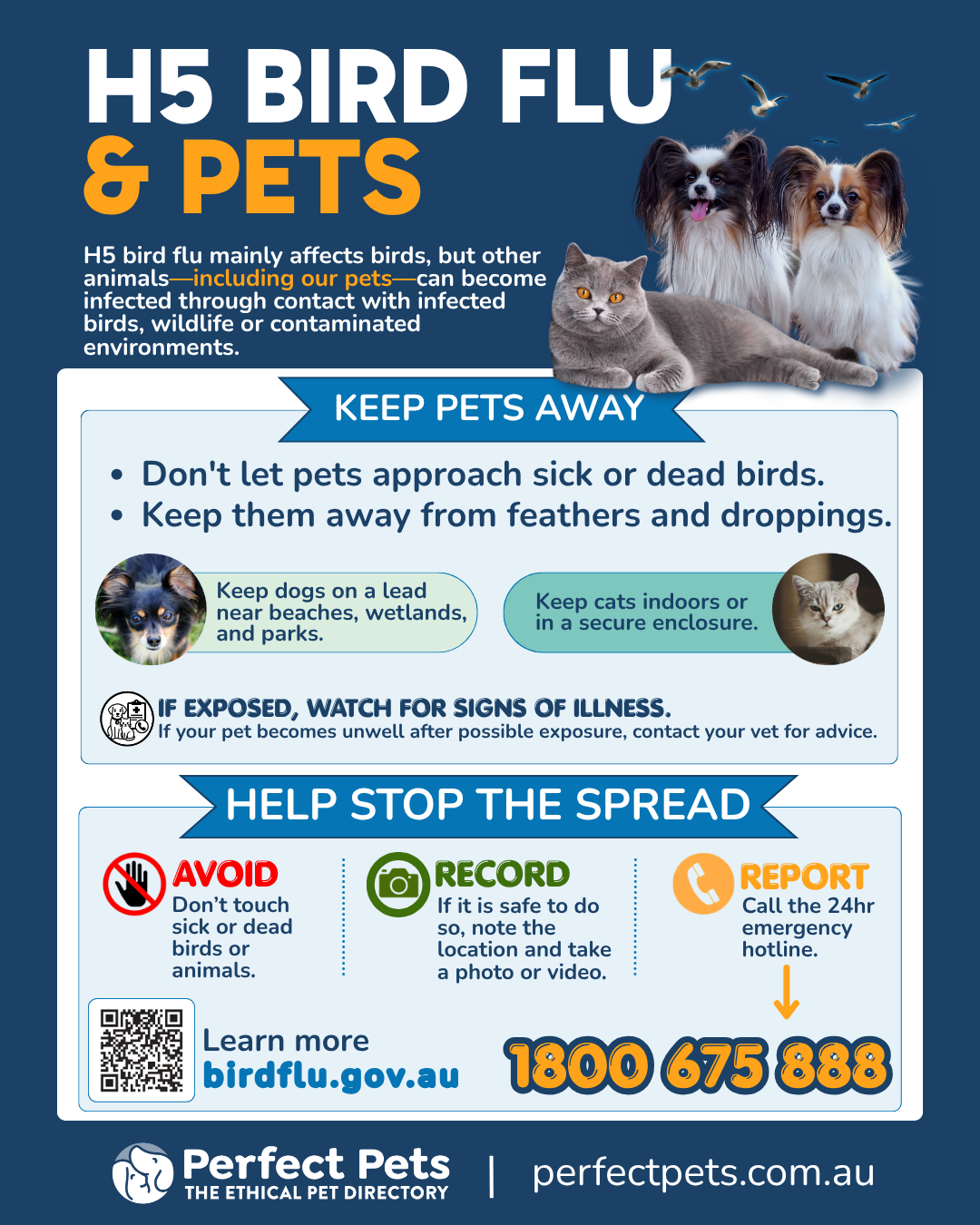
Infographics & posters: Bird flu & pets
Help keep our pets safe and reduce the spread of H5 bird flu - download and share on social media, website, or print for your clinic, rescue or community noticeboard.
Is it true that half of infected cats die?
The short answer: the real figure is higher than half, but it is widely misread. Studies of cats infected with H5N1 have reported very high death rates. A systematic review of two decades of cases found a fatality rate of around 90% for the strain now circulating, and the Cornell Feline Health Center reports that up to 70% of infected cats die. These are serious numbers, and they reflect that the illness is often severe once it takes hold.
In almost all of those recorded cases, the cats were tested because they were already gravely ill or had died. Milder infections often go untested and uncounted, so researchers note the true fatality rate is likely lower than these figures suggest — they are an overestimate.
So the key takeaway is that infection is uncommon, but can be very serious, even deadly, for cats that contract it. Keeping cats away from sick or dead birds is what matters the most.
How can I protect my pets?
Governments are now saying this directly. After H5 bird flu was confirmed in a red fox in suburban Adelaide, South Australia’s Primary Industries Minister, Clare Scriven, asked pet owners to restrict their pets’ movements: dogs on a lead and away from dead or sick birds and wildlife, and cats kept inside. As she put it, we already keep cats in so they don’t attack birdlife — in this case it also protects the cat. Australia’s Chief Veterinary Officer, Dr Beth Cookson, made the same point when confirming the fox: it is a reminder that people and their pets should avoid sick or dead wildlife.
The following steps are drawn from Australian and veterinary guidance and reduce the chance of a pet being exposed:
- Keep pets away from sick or dead birds and other wildlife. Don't let dogs approach or mouth them, and don't let cats hunt or scavenge them.
- Keep cats indoors or in a secure enclosure. This prevents hunting and scavenging — the main exposure route for cats — and protects native wildlife at the same time.
- Keep dogs on a lead in areas where wildlife are present.
- Don't leave pet food or water outside where wild birds and animals can reach it. Anything that gathers wild birds in one place — bird baths, water dishes, feeding stations — can help disease spread between them.
- Wash your hands with soap and water before and after handling birds or other animals, and after handling bird feeders. If you have had contact with birds, livestock or wild animals, change your clothes and footwear before contact with your pets.
In countries where the strain is circulating in poultry and dairy — such as the United States — cats have been infected through raw or undercooked poultry, freeze-dried raw diets, or raw (unpasteurised) milk, and authorities there advise against feeding these to pets. Cooking and pasteurising inactivate the virus. This isn't a documented route in Australia at this stage, but if H5 becomes established here the same precaution would apply.
For most pets the practical risk remains low — indoor cats without these exposures are unlikely to be infected — but these simple steps remove the main avoidable risks.
The virus can survive in a dead bird's body for a long time — researchers estimate up to around 30 days at 20°C, and considerably longer in colder conditions. That means a carcass stays a source of infection well after the bird has died, and any animal that scavenges or even mouths it can be exposed. This is the main reason to keep pets well away from dead birds or remains - not just visibly sick birds.
If you keep backyard poultry or pet birds
Pet birds, aviary birds and backyard poultry are more exposed than cats or dogs, because H5 bird flu spreads most readily between birds. There are no reports of infection in pet or aviary birds in Australia at this stage. The main risk is contact with wild birds — especially waterfowl — and contamination from their droppings. Birds housed in enclosed aviaries, where feed and water cannot be reached by wild birds, are at low risk.
- Keep wild birds out. Cover aviaries and runs where you can, using mesh fine enough to keep even small wild birds out, and keep feed and water where wild birds cannot reach or foul them.
- Store feed securely in sealed containers, and clean feed and water containers regularly.
- Give clean, fresh water. Provide drinking water from a mains or tank supply rather than from a dam or other source that wild birds use, and site it where wild birds cannot foul it.
- Practise good hygiene. Wash your hands before and after handling your birds, clear droppings and waste promptly, and avoid sharing equipment between aviaries unless it has been cleaned and disinfected. Keeping a dedicated pair of shoes for the coop — worn only there and not brought inside — is a simple extra precaution, especially if you also have a cat or dog at home.
- Quarantine new birds for at least 30 days before introducing them to your flock, and tend to them last. Source birds from reputable breeders rather than markets.
Signs of H5 bird flu in birds can include sudden death, lethargy, laboured breathing, swelling around the head, and a sudden drop in egg laying. If you suspect it, do not move your birds — call your veterinarian, and report it on 1800 675 888. Avian influenza is a nationally notifiable disease.
Bird events are being affected. The Royal Adelaide Show has cancelled all poultry and pigeon competitions for 2026 — around 1,600 classes covering eggs, pigeons, bantams, ducks, fowl and geese. If you show or sell birds, check with organisers before travelling.
How do I report a sick or dead bird?
Community reports are how surveillance teams track where the virus is and identify locations that need investigation. Australians have made more than 25,000 reports to the Emergency Animal Disease Hotline since the outbreak began, and the country’s first confirmed mammal case came from a member of the public reporting a dead seal on a beach. Report early — even a single sick or dead bird is worth reporting, and you don’t need to wait for an obvious outbreak.
Wildlife Health Australia and the Department of Agriculture, Fisheries and Forestry use a simple three-step approach: Avoid. Record. Report.
Avoid — do not touch sick or dead birds or other animals, or their immediate environment. Keep your distance and keep pets away.
Record — note the number of animals affected, the type of bird or animal, the location (a GPS pin, nearby roads or landmarks), and the date and time. Take photos or a video if it is safe to do so.
Report — call the 24-hour Emergency Animal Disease Hotline on 1800 675 888. This number connects you to the relevant officer in your state or territory. Avian influenza is a nationally notifiable disease, which means that if you suspect it, you are legally required to report it.
Victoria publishes a public map of the reports made to its wildlife surveillance program. It shows the approximate location of sick or dead wild birds, marine mammals and other wildlife reported to the Department of Energy, Environment and Climate Action, and is updated each weekday. You can filter it by species group and change the date range. It is worth a look if you have ever wondered what happens to a report after it is made. See the map via Agriculture Victoria.
For current, authoritative information, we recommend the official sources below:
- The national bird flu campaign site, birdflu.gov.au, is updated as the situation develops, and the Department of Agriculture, Fisheries and Forestry publishes downloadable posters and fact sheets in a range of languages.
- Your state or territory biosecurity agency has local guidance: NSW, Victoria, Queensland, South Australia, Western Australia, Tasmania, Northern Territory, and the ACT.
What is H5 bird flu?
Bird flu, or avian influenza, is a viral disease that mainly affects birds but can infect other animals. The strains are grouped as either low pathogenicity (LPAI), which usually causes little or no illness, or high pathogenicity (HPAI), which can cause severe illness and death in poultry and, sometimes, in wild birds.
H5 bird flu is high pathogenicity avian influenza H5N1. It includes the H5N1 clade 2.3.4.4b strain, which has spread around the world since 2021 through the movement of wild birds, with an impact not seen before. It has now been detected in over 600 species of birds, and has crossed into many wild and domestic mammals as well — seals among the hardest hit. Millions of wild birds have died, and some species have seen sharp falls in their global numbers.
How did it reach Australia?
One likely route is through the sub-Antarctic. H5 bird flu was confirmed in June 2026 on Heard Island — a remote sub-Antarctic Australian external territory roughly 4,000 kilometres south-west of Perth — where it has been linked to the deaths of over 13,000 elephant seal pups. The virus has been moving steadily through the sub-Antarctic, and seabirds reaching the Western Australian coast from that region is one way it could be carried closer to the mainland.
The other route is the movement of migratory birds. Each year, shorebirds arrive in Australia from the northern hemisphere between roughly August and November, and waterfowl move down from regions to Australia's north — either can carry the virus. That spring migration window is now opening, which is why authorities expect the risk of further spread to rise over the coming months.
What would it mean for Australia's wildlife?
The greatest concern with H5 bird flu is its impact on wildlife. Overseas it has killed wild birds and some mammals in very large numbers — seabirds, waterfowl and birds of prey among the birds, and seals and sea lions among the mammals. Australia has now recorded its first such loss of native wildlife to the virus, and authorities expect the spread to widen as migratory birds arrive. Because many of our native animals are found nowhere else and have never encountered this virus, the impacts here are hard to predict.
This is why early reporting matters so much: surveillance built on reports from the public is one of the few tools available to track the virus and respond, and there is no treatment for H5 bird flu in wildlife. Read more about H5 bird flu and Australia's wildlife — for the risks to seals, seabirds and other native species, and how wildlife carers can help.
Is there a risk to human health?
H5 bird flu is primarily a disease of wild birds and mammals, and the risk to the general public is low. Human infections are rare, usually mild, and are generally associated with close contact with infected animals or their environments. There is no evidence of sustained spread between people. Because influenza viruses can change over time, health authorities monitor the situation closely and are working with experts to make sure Australia is prepared — but this reflects caution, not a current threat to people going about their day.
The practical advice is the same as for protecting wildlife and pets: avoid contact with sick or dead birds and animals, keep your distance, and report what you see. It is safe to eat properly handled and cooked poultry, eggs and egg products.
How can we help?
Save the 24 hour Emergency Animal Disease Hotline number to your phone 1800 675 888. Researchers and biosecurity authorities depend on reports of sick and dead wildlife to track where the virus is and respond quickly.
If you find this page useful, please share it — the more pet families and people who spend time outdoors who know what to look for, the better.
Share on Facebook Share on X Share on LinkedIn Share by email
References
- Dr Sally Coggan, ABC News interview, 4 August 2026.
- Hon Julie Collins MP (Federal Minister for Agriculture, Fisheries and Forestry) and Hon Jackie Jarvis MLC (WA Minister for Agriculture and Food), press conferences, 19 June 2026.
- Wildlife Health Australia. H5 Avian Influenza (H5 Bird Flu) and Wildlife — Advice for people who encounter sick or dead wildlife. Version 5.0, June 2026. wildlifehealthaustralia.com.au
- Wildlife Health Australia. H5 bird flu resource centre. wildlifehealthaustralia.com.au
- Department of Agriculture, Fisheries and Forestry. Report suspected bird flu. agriculture.gov.au
- Department of Agriculture, Fisheries and Forestry. About bird flu. agriculture.gov.au
- Department of Climate Change, Energy, the Environment and Water. Prepare pets and wildlife for H5 bird flu. 17 September 2025. dcceew.gov.au
- Australian Antarctic Program. Scientists determine extent of H5 avian influenza (bird flu) outbreak at Heard Island and McDonald Islands. 18 June 2026. antarctica.gov.au
- Wille M. Chickens, ducks, seals and cows: a dangerous bird flu strain is knocking on Australia's door. Doherty Institute / The Conversation. doherty.edu.au
- Wille M. The first case of H5N1 bird flu in Australia has been confirmed. What does this mean? Doherty Institute, 24 June 2026. doherty.edu.au
- Richards S, Fellman C, DeStefano I. Avian Influenza and Feline Patients. Today's Veterinary Practice, May/June 2026 (1 May 2026). todaysveterinarypractice.com
- Coleman KK, Bemis IG. Avian Influenza Virus Infections in Felines: A Systematic Review of Two Decades of Literature. Open Forum Infectious Diseases, May 2025. academic.oup.com
- Interim Australian Centre for Disease Control. Bird flu (avian influenza). cdc.gov.au
- World Organisation for Animal Health (WOAH). Avian influenza. woah.org
- Department of Agriculture, Fisheries and Forestry. H5 bird flu detection — national update. As at 27 August 2026. agriculture.gov.au/campaigns/birdflu
- H5 bird flu strain detected in Australian seabird for first time. ABC News, 10 July 2026. abc.net.au
- NSW Department of Primary Industries and Regional Development. Avian influenza. dpird.nsw.gov.au
- Scavenger animals are the missing link in Australia's bird flu response — three experts explain. The Conversation, 8 July 2026. theconversation.com
- Australian Veterinary Association. High Pathogenicity Avian Influenza. ava.com.au
- Kellett P (North Hobart Veterinary Hospital). How to protect pets from bird flu. Interview, ABC Radio Hobart, 9 July 2026. abc.net.au
- Agriculture Victoria. H5N1 avian influenza (H5 bird flu) — current situation. As at 30 July 2026. agriculture.vic.gov.au
- Deadly H5N1 bird flu strain detected in Victoria for first time. ABC News, 30 July 2026. abc.net.au
- Department of Agriculture, Fisheries and Forestry. H5 bird flu updates — statement of the Australian Chief Veterinary Officer, Dr Beth Cookson. 28 August 2026. agriculture.gov.au
- First H5N1 bird flu detection confirmed in Australian dolphin. ABC News, 28 August 2026. abc.net.au
- Suspected bird flu infection in fox sparks fears of long-distance spread. ABC News, 26 August 2026. abc.net.au
- Australia records its first bird flu case in a mammal, minister says. ABC News, 23 August 2026. abc.net.au
- Bird flu vaccine to be rolled out for Australia’s most at-risk native species. SBS News, 11 August 2026. sbs.com.au
- First bird flu mass mortality confirmed in Australian wildlife. ABC News, 3 August 2026. abc.net.au