
Dog Pedigree Papers: A Guide to Australian Pedigrees
If you're looking for a purebred puppy, the word "pedigree" is often part of the conversation. Pedigree documents in Australia are issued by Dogs Australia, the not-for-profit peak body for purebred dogs, as well as by newer organisations and businesses — this page explains what a pedigree is and how dog pedigrees work in Australia.
- A dog pedigree is an official document drawn from a national stud book — not just a family tree on paper.
- A pedigree confirms the dog comes from a documented breed background — meaning temperament, behaviour, size, and appearance are generally more predictable than with an undocumented dog.
- In Australia, pedigrees from Dogs Australia are recognised internationally through the Fédération Cynologique Internationale (FCI), with reciprocal recognition arrangements with the Kennel Club in the UK and the American Kennel Club.
- A Dogs Australia pedigree involves a registered prefix, breed-specific health testing where required, and breeder adherence to Dogs Australia's code of practice.
Dogs Australia and its state bodies
The peak body
Dogs Australia, established in 1958 as the Australian National Kennel Council (ANKC), maintains the country's internationally recognised stud book for purebred dogs. It supports state and territory member bodies nationwide - DOGS NSW, Dogs Victoria, Dogs Queensland, Dogs SA, Dogs West, TasDogs, Dogs ACT and Dogs NT.
International recognition
Dogs Australia is an Associate Member of the Fédération Cynologique Internationale (FCI) — the world's peak international canine body, with member organisations across most of the world. It maintains reciprocal registration agreements with the Kennel Club (UK) — founded on 4 April 1873, with its stud book published continuously since December 1874 — and the American Kennel Club (AKC).
In practical terms, this means a dog with a Dogs Australia Main Register pedigree can be registered with Dogs Australia recognised kennel clubs overseas, shown at international events, and exported with full recognition of its lineage. Pedigrees from a recognised overseas canine body are likewise accepted for registration with Dogs Australia, though acceptance and classification can vary by country, breed, and variety.
Newer organisations and businesses
Several newer organisations and businesses also issue documents called pedigree papers, including for crossbreeds and mixed breeds. These bodies have different histories and oversight structures, and operate outside the international networks used by Dogs Australia.
Breeder requirements also differ between the two systems. For example, Dogs Australia requires breed-specific health testing for certain breeds before a litter can be registered (under its Litter Registration Limitations). Several newer organisations don't require this type of disease screening.
Confusion about what pedigree papers actually represent is widespread, and it can cost people money and heartbreak if it turns out that the standards they expected with pedigree papers aren't there.
If you find this page useful, please share.
Share on Facebook Share on X Share on LinkedIn Share by email

Skye & Bella, courtesy of Kris - Heidi, Skye Bella
What a Dogs Australia pedigree includes
A Dogs Australia pedigree includes:
- the puppy's registered pedigree name and Dogs Australia registration number
- breed, sex, date of birth, colour and coat type
- microchip number
- country of origin
It also provides:
- the breeder's name and the state body that issued the pedigree
- the registered owner
- the litter registration date and the pedigree issue date
A three-generation family history follows, showing each ancestor's kennel prefix, registration number, and any titles recorded against them. Pedigree papers use standardised abbreviations to record show and sporting titles — for example, "Ch" (Champion), "Gr Ch" (Grand Champion), "Sup Ch" (Supreme Champion). Imported dogs are noted with "(Imp UK)" or similar to show their country of origin.
The pedigree is a council-verified record of lineage. Without papers from a recognised body, the lineage isn't documented through Dogs Australia's stud book. With Dogs Australia papers, the lineage has been registered, recorded, and can be checked against Dogs Australia's records.
To register a litter with Dogs Australia, and have pedigree papers issued, a breeder must:
- Hold a registered prefix — their unique kennel name — which requires passing a Breeder Education programme
- Register every litter with their state body before the litter reaches 12 months of age
- Comply with any Litter Registration Limitations that apply to the breed (these are mandatory disease screening tests for the sire and dam)
- Comply with strict regulations around close inbreeding — first-generation matings such as father/daughter, mother/son, or brother/sister are not permitted on the Main Register
- Operate within the Dogs Australia Codes of Practice
Test results may be linked from ORCHID, the Officially Registered Canine Health Information Database.
If you've been shown or given pedigree papers that don't look right — missing details, inconsistent registration numbers, a body you can't find online, or anything else that's suspicious — we can take a look for you. We have breeders with decades of experience reading pedigrees who can review the document.
Email a clear photo or scan to Perfect Pets Pedigree Check along with the breeder's name, contact details and the registering body shown on the document and we'll assess from there.
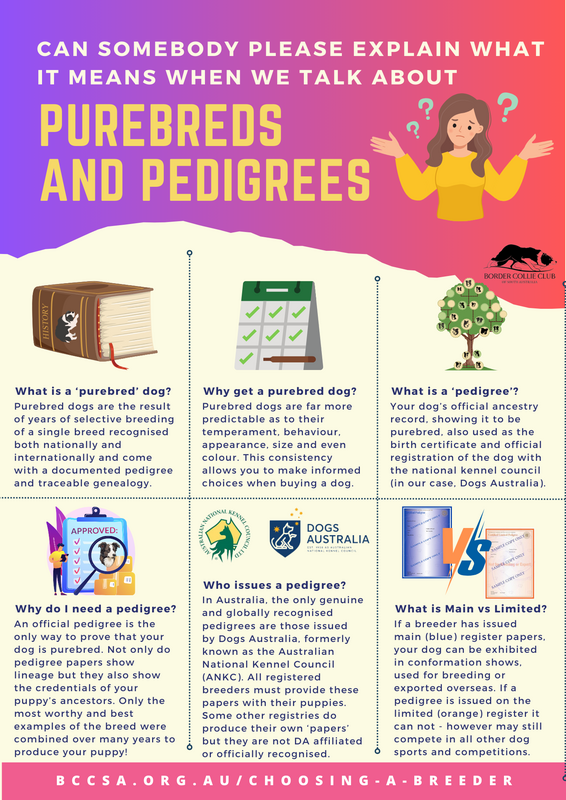
Infographic courtesy of the Border Collie Club of South Australia.
Main Register and Limited Register
Dogs Australia issues two types of pedigree paper. Both are Dogs Australia pedigrees drawn from the same stud book, and both confirm the dog as fully purebred. The difference is in what the dog is permitted to do. Within a single litter, breeders may choose to place some puppies on the Main Register and others on Limited Register, depending on the home each puppy is going to.
Main Register (blue papers)
Allows the dog to be shown in conformation events, to be used for registered breeding, and to be exported overseas with full international recognition. This certificate allows you to breed and show your pup at Dogs Australia sanctioned events (this doesn't guarantee that your pup is of breeding and showing quality).
Limited Register (orange papers)
For dogs placed in pet homes rather than breeding programmes. Limited Register dogs cannot be shown in conformation, used for registered breeding, or exported — but they can compete in every other Dogs Australia activity and dog sport. That includes obedience, agility, rally, scent work, dock diving, herding, lure coursing, tracking, and tricks. Your pup is of pet quality but you can still enter them in any other dog sports you wish.
Beyond the pedigree register — dog sports for all dogs
Dogs Australia runs a broad programme of dog sports — including obedience, agility, rally, tracking, herding, scent work, lure coursing, dances with dogs, and trick dog. It recognises that non-pedigree dogs deserve the chance to take part too.
The Associate Register is open to dogs without a certified pedigree. They can compete in any of these Dogs Australia performance events except conformation. They must be desexed.
There's also a Sporting Register for dogs registered with another canine body recognised by Dogs Australia (a "kindred body"), which allows them to compete under Dogs Australia rules.
This means Dogs Australia events are open to a much wider community than just pedigree dogs — a fact worth knowing if you have a beloved dog of mixed background and want to enjoy dog sports together. See Dogs Australia dog sports for the full programme.
If in doubt, ask two questions: Which body issued the pedigree? And is the breeder a current financial member of their state or territory Dogs Australia body?
Frequently asked questions
What are pedigree papers for a dog?
Pedigree papers are an official document that records a dog's ancestry going back several generations. A pedigree is drawn from a national stud book maintained by a recognised canine council (in Australia, Dogs Australia) and shows that the dog comes from a recorded lineage of registered pedigree dogs.
What's the difference between Main Register and Limited Register papers?
A Main Register pedigree (blue papers) allows a dog to be shown in conformation events and used for registered breeding. A Limited Register pedigree (orange papers) is for dogs placed in pet homes — they can't be shown in conformation or bred from, but they can compete in every other Dogs Australia activity and dog sport, including obedience, agility, rally, scent work, dock diving, herding, lure coursing, and tracking. Both are Dogs Australia pedigrees drawn from the same stud book.
Are Dogs Australia pedigrees recognised internationally?
Yes. Dogs Australia is an Associate Member of the Fédération Cynologique Internationale (FCI), with reciprocal recognition arrangements with the Kennel Club in the UK and the American Kennel Club (AKC).
Can a non-pedigree dog compete in Dogs Australia events?
Yes. Dogs Australia operates an Associate Register for dogs without a certified pedigree. Associate Register dogs can compete in a wide range of Dogs Australia performance events — including obedience, agility, rally, tracking, and herding — but not conformation. They must be desexed.
What is a registered prefix?
A registered prefix is a breeder's unique kennel name, registered with their state Dogs Australia body. Every puppy a breeder produces is registered under that prefix. Prefix names follow specific rules: a single word of 4 to 12 letters, no numbers or punctuation, not similar to an existing prefix, and not containing a breed name. To obtain one, a breeder must complete a Breeder Education programme and maintain financial membership of their state body. It's one of the clearest markers of an established registered breeder.
Do pedigree dogs need health testing?
It depends on the breed. Some breeds have Litter Registration Limitations — health screening rules breeders must meet before registering a litter. Each breed community votes on what tests apply, with input from registered breeders, State Breed Clubs, and National Breed Councils. Common Dogs Australia–recognised schemes include the Canine Hip and Elbow Dysplasia (CHED) scheme, the Australian Canine Eye Scheme (ACES), BAER hearing testing, and DNA tests for specific genetic conditions. Ask your breeder which tests apply to your puppy's breed, and ask to see the results. Test certificates may carry a QR code that can be scanned to verify their authenticity.
How can I check if a dog breeder is properly registered?
Ask which state or territory Dogs Australia body the breeder is a financial member of. You can confirm membership directly with the relevant body. For a guide to state government breeder registers, see our breeder verification checklist.
What if I lose my dog's pedigree papers?
To request replacement pedigree papers, contact the state or territory member body of Dogs Australia that issued the originals.
You'll usually need to provide proof of ownership, the dog's microchip number, the original registration details if you have them, and the breeder's information. A replacement fee applies, and processing typically takes a few weeks.
The state and territory bodies are: Dogs ACT, DOGS NSW, Dogs NT, Dogs Queensland, Dogs SA, TasDogs, Dogs Victoria, and Dogs West.
At Perfect Pets, we have always required that our dog breeder members are registered with Dogs Australia-affiliated state bodies. This has been our standard since we launched in 2013, and it hasn't changed.
Learn more about how to find a responsible breeder and how we verify every breeder before they're listed.