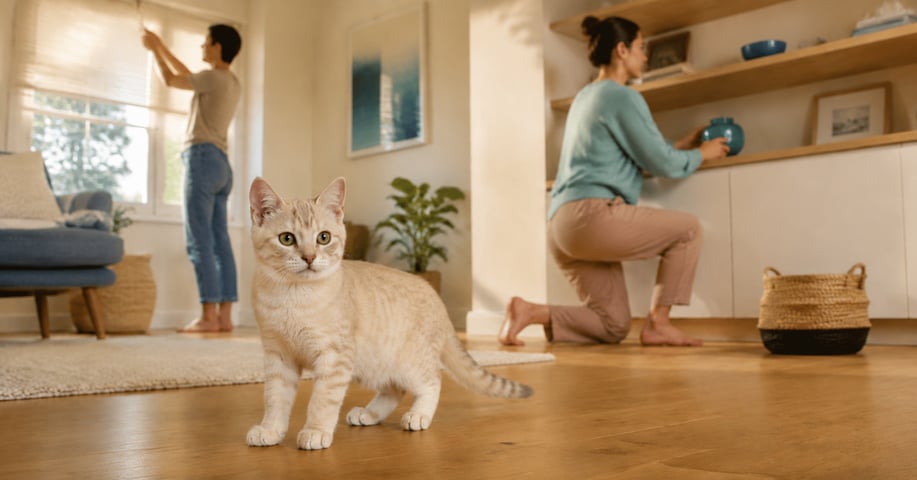
Preparing for your new kitten -The human household hazard detector
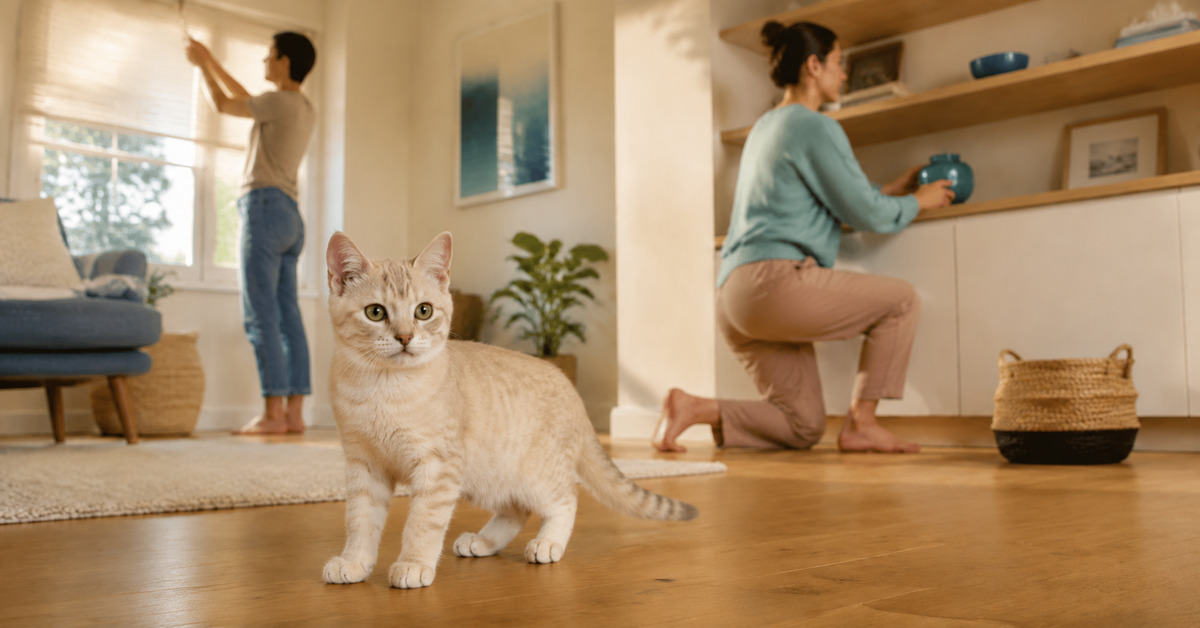
Before you bring home your new kitten, whether it is the first you have ever owned, or even if you already have mature feline residents, you need to play a little mind game, and take a new look at your house.
See Your Home Through a Kitten’s Eyes
Close your eyes and in your mind, down on all fours, grow a tail and shrink! You are now about 10cm tall, and about 15-20 cm long, with an unpredictable rear extension.
Be extremely athletic. You are now able to jump at least 3-4 times your own height, you can climb vertical surfaces.
Be extremely flexible. You can squeeze yourself through tiny holes, you can touch the base of your tail with your tongue, you can pick your way through a maze of small objects
Be curious You test everything new with your tongue, paws and nose.
NOW you may open your eyes again and look around your room trying to imagine what hazards it presents to the newly arrived kitten and how such hazards may be reduced.
Essential Kitten-Proofing Checks
- Put away fragile and valuable items in easy reach of the kitten.
- Have somewhere secure to put the kitten while you are eating.
- You may think it is out of reach, but is it really?
- Tails are often not well controlled ....
- Be absolutely certain that the room is escape proof before letting the kitten in. (It’s very embarrassing to do a letter box drop, ring all the vets, and cry down the phone to the breeder, only to have the kitten stroll out at tea time....)
- Kittens are able to creep into the tiniest spaces, and they sleep much more solidly than an adult cat, so don’t necessarily hear or respond to your call.
- The toilet bowl must be kept shut if the kitten even might have access to it at any time. The slippery sides often prevent a small kitten from climbing out, and it can chill, tire, and drown.
- Beware of leaving thready type materials around, particularly synthetic threads, such as fishing line. If the kitten has a thread hanging from its mouth, and it doesn’t come easily on a gentle tug, you must seek veterinary help. (And the removal can be VERY expensive)
- Beware of situations where a kitten could strangle itself. This often takes considerable insight – a lace curtain will be OK when the kitten has grown too much to put its head through a pattern hole, on the other hand, a hole in damaged fabric could be the size to catch an unwary kitten of any age.
I think you could now return to normal human dimensions, while we detect other hazards, not necessarily of the falling on/off, ingesting and entangling type....
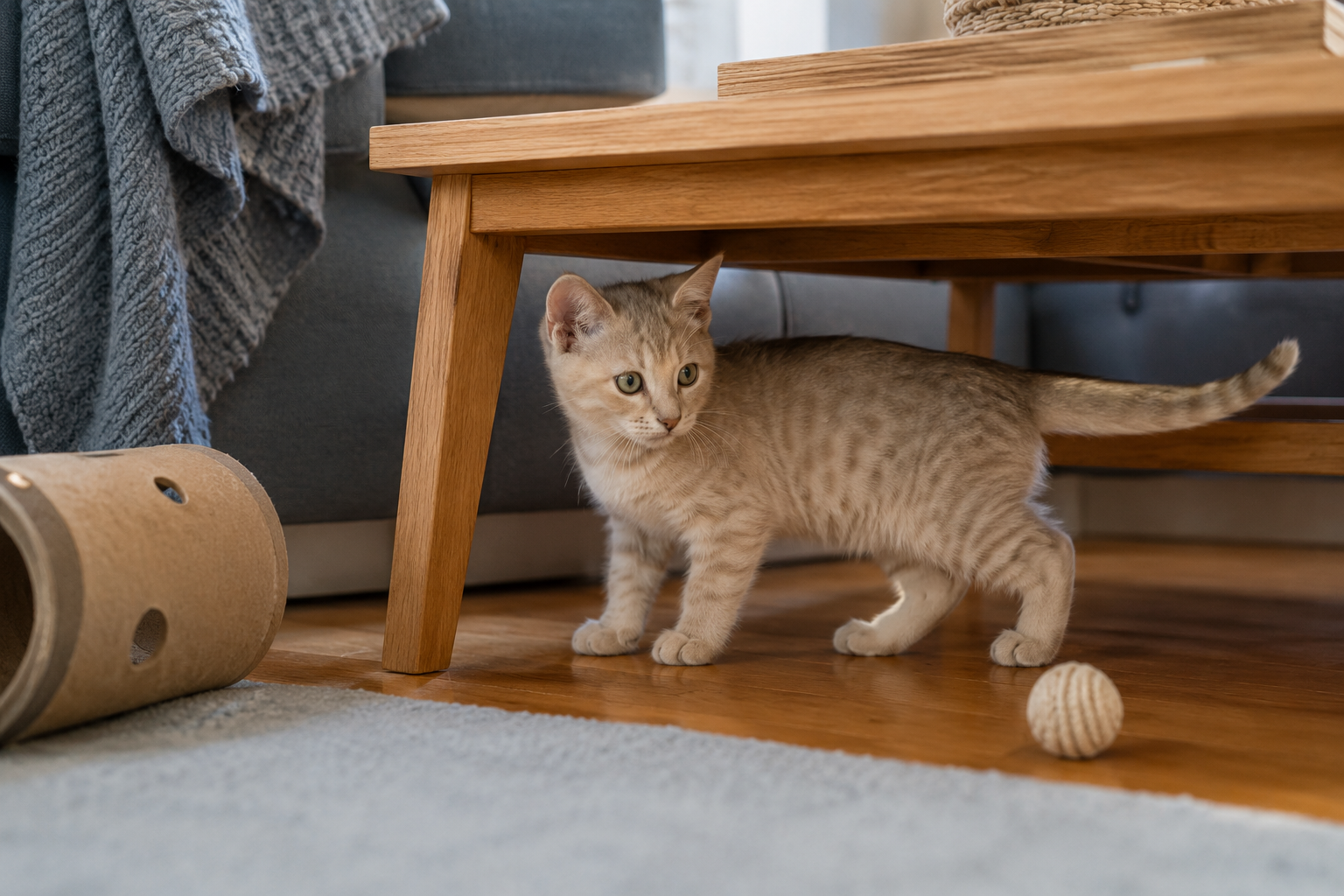
Common Household Poisons
Firstly, common house and garden poisons - and yes, it is quite likely that you do use some - even just the odd spot of fly spray - it is a good idea to remove the corpses of the flies as soon as they are killed - kittens like to eat any little thing they find.....
Rat Bait and Mouse Poison
Do you have a mouse problem - the mice come in under the dishwasher, perhaps, and so you have put some trays of rat bait under the fridge, - well, the kitten will be round the back of the fridge, and right inside the works as quick as a flash, coming out all covered with dust ... make sure it isn’t full of rat poison as well ... (prompt veterinary attention for suspected rat poisoning is essential, the treatment is usually very successful).
Human Medication
Do you need to take medication daily? Keep it in a safe place, and out of the closed containers only when you are actually taking it. Most human medication, even if it is the same as used for cats, provides excessive dose levels for a kitten, and some is downright dangerous - particularly aspirin, which can be used in some other animals, but not felines. Foil packed tablets make a great toy - but if they are chewed, the sharp little kitten teeth easily penetrate the packaging...or the kitten could just choke on the whole thing while trying to swallow it...
Cleaning Products and Disinfectants
I’m sure you keep your house clean .... but what do you use? A great many house cleaning and disinfecting agents are poisonous to cats - so you may need to change your basic cleaning agents. SAFE are quaternary ammonium compounds, and hypochlorite type bleaches, used at the strength recommended on the container for household cleaning. DANGEROUS are compounds based on coal tar derivatives, pine oil, and eucalyptus oil. This means Dettol, Pine’o’Clean are out, as are detergent with eucalyptus oil. I would also be careful of Tea Tree oil products, including ointments, as these have induced acute allergic reactions in some cats.
Kitten Hazards in the Garage and Workshop
In the garage therefore it is obvious that care should be taken not to get grease or oil on the kitten, specially not leave old trays of oil around into which it might fall. Should the kitten become oil covered, it is vitally important that it doesn’t lick itself, but it should be bathed in warm water with dish washing detergent, and rinsed thoroughly, then shampooed with a gentle baby or cat shampoo. Thorough rinsing and drying are essential. Other hazards of the workshop, such as paint, thinners etc etc may require specialist assistance from the vet to remove - though where they can be washed off the kitten, this should be the first action ..... If you suspect that the kitten could have ingested any of these products, it most certainly needs veterinary attention --Poison’s advice services are for humans, and may provide unsuitable/impractical remedies for a kitten. And a general note on shampoos, use only those specifically recommended for cats many DOG shampoos will kill a cat.
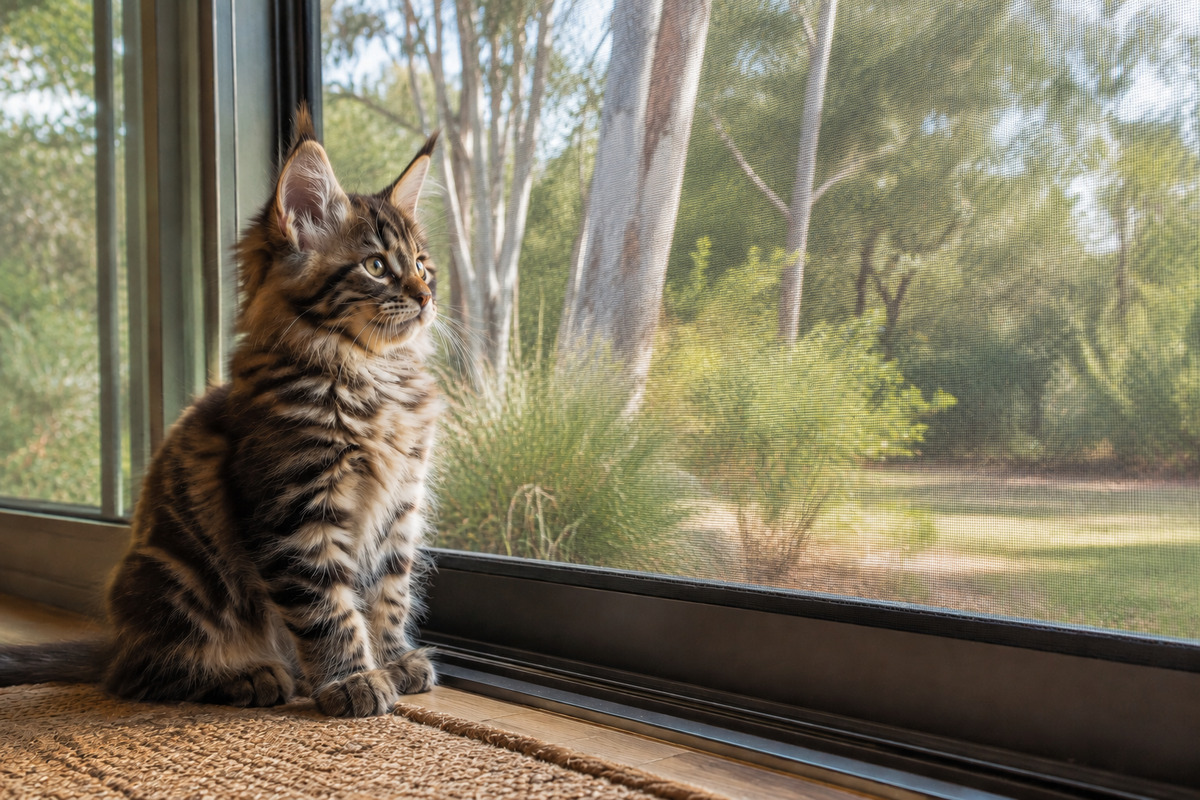
Making the Garden Safer for Your Kitten
The garden is of course a very interesting, and potentially more hazardous place - over some hazards you have little control - but you can avoid poisoning your kitten with snail bait, or letting it play in the garden immediately after you have sprayed crops or weeds with insecticides and weed killers. Of plants themselves, there are many lists available through a google search, but a particular warning against Asiatic lilies should be given. These are more likely to be encountered in the vase, rather than the garden. Just licking up a spot of pollen which has fallen on the kitten can lead to non reversable kidney damage and death.
Spiders and Other Creepy Crawlies
It is difficult to avoid the eating of small creepy crawlies, and on the whole these may make the kitten vomit, but nothing much else. However, red back spider bite needs veterinary attention - it is slow to provoke symptoms, but these often persist over weeks or even months - the symptoms can easily be treated even a long time later, if you have even a suspicion that the kitten has been bitten by a red back.
Bee and Wasp Stings
Immediate symptoms of an apparently alarming nature result from bee/wasp stings - if the kitten has a ‘fat foot’ by all means ring the vet, but generally this will be resolved in time - however, the sting should be removed, and if you don’t feel confident of doing so without injecting more venom in the process, take the kitten to the vet. If the kitten has been stung around the face, or in the mouth, a vet visit is automatic, localised swelling could choke the kitten. Likewise if the kitten becomes quiet, or shows any kind of distress in breathing, after a witnessed or suspected sting, it needs immediate veterinary treatment to prevent its lungs filling with fluid, and of dying, essentially of drowning. Keep the kitten as quiet as possible, prop it with its chest and head up, and race to the vet (get someone to ring as well to warn of your coming), and demand that you are let in to the vet immediately, no one will mind if you queue jump - this is a real emergency. The prognosis is good if you get there with the kitten still breathing.
Garden Bugs, Ticks and Snakes
Some unsuspected bugs, such as green vegetable bugs, citrus bugs, and many beetles exude highly caustic/aromatic poisons when touched. Some cats will respond to these in the same way as the sting of a bee or wasp, and require immediate veterinary attention. Paralysis ticks and snake bite are both potential garden hazards to a kitten, if they are likely to be a problem for you, speak to your vet.
Human Foods and Your Kitten
Many human foods are perfectly acceptable to your kitten, meats, fish, eggs, milk products, some vegetables, grain, pasta etc - though on the whole there will be no great enthusiasm for the last three, as they are rather outside the normal diet of a cat. Some things should always be avoided though - and alcohol would be the top of the list, followed by hot and powerful spices, such as chilli, mustard etc. It is unlikely that any self respecting cat would actually eat any of these things, but kittens are much less wary, and may eat enough to seriously burn or damage their digestive tract, and to cause such pain is inexcusable. Coffee and chocolate are also a no no. Foods which are very common causes of human allergies, such as fungi (mushrooms etc) and shellfish should probably also be avoided.
A Little Forethought Goes a Long Way
While you can’t wrap your kitten in cotton wool, you can with a little forethought and attention to detail, remove a great many potential home hazards which may lie between it and maturity.